Why Eating Well Feels Impossible With ADHD (And What Actually Helps)
Eating well with ADHD is like running a marathon in ankle weights while everyone else looks effortless.
If you have ADHD and you struggle to eat well, it's not because you lack discipline. Not because you don't care about your health. And it's definitely not because you haven't found the right diet yet.
It's because eating well requires a long chain of executive functions that ADHD directly disrupts. And almost nobody designs nutrition advice with your brain in mind.
I'm not going to tell you there's one easy fix. You're an individual and it doesn't work like that. But what I do know is this: there is always a way forward.
So let's look at nutrition through the lens of how an ADHD brain actually works, not how we wish it worked, and build something real from there.
What eating well actually requires
Think about everything that has to happen between "I'm hungry" and "I ate a real meal."
You have to notice you're hungry. Then stop what you're doing. Then decide what to eat. Then check if you have the ingredients. Then actually make it. Then sit down and eat it.
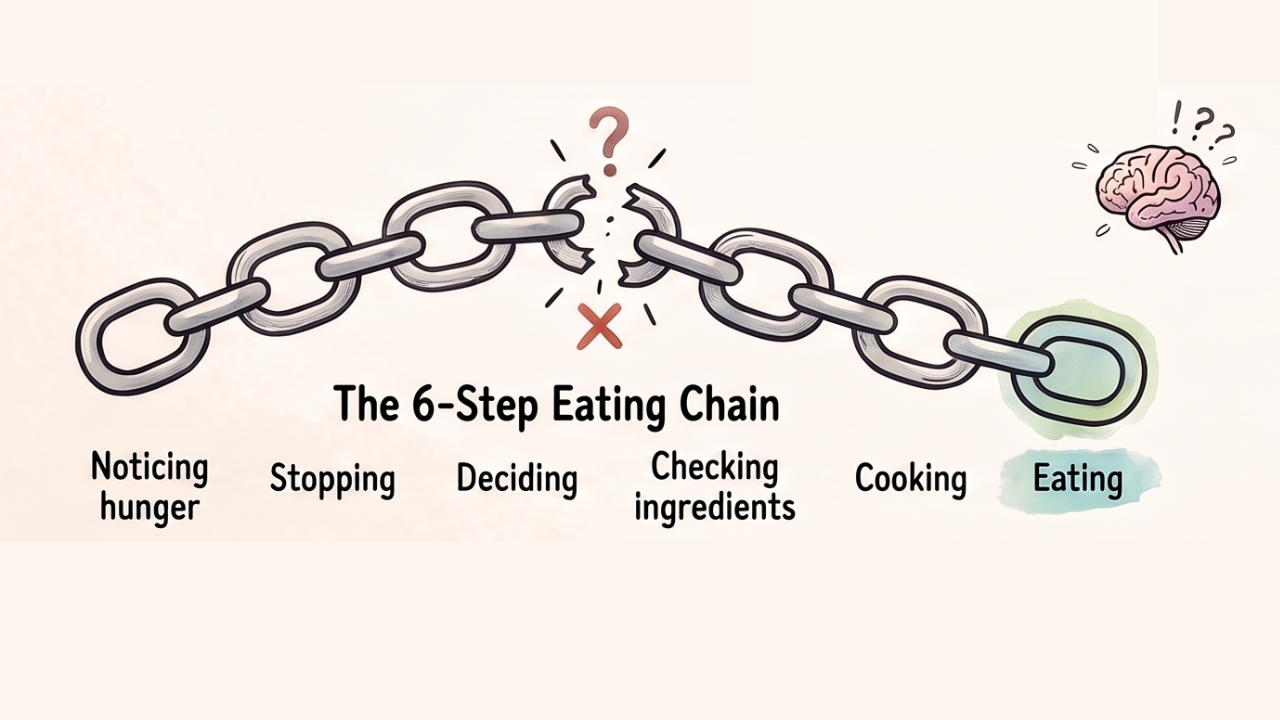
That's six executive function steps before you've taken a single bite.
ADHD disrupts attention, working memory, task initiation, impulse control and time perception. Every single one of those is involved in the process of feeding yourself properly.
So when an ADHD brain hyperfocuses on something and suddenly realises it's 3pm and they haven't eaten since 7am, that's not carelessness. That's neurology. When the fridge feels overwhelming and a packet of crackers wins, that's not laziness. That's decision fatigue. When the plan was to cook something healthy and instead you ordered takeaway for the fourth time this week, that's not failure. That's a system that was never designed to work with your brain.
The goal isn't to try harder. It's to build a better system.
What your brain actually needs
Before we get to the practical stuff, it helps to understand what's going on neurochemically. Because once you understand why certain foods and eating patterns matter for an ADHD brain specifically, they stop feeling like rules and start feeling like tools.
Dopamine is the central issue.
ADHD is heavily regulated by dopamine dysregulation. The brain produces and uses dopamine less efficiently, which affects motivation, focus, impulse control and emotional regulation. This is why ADHD medication works, it raises dopamine availability in the brain.
Food doesn't replicate medication. But it does influence the raw materials your brain uses to make dopamine. And it directly affects how well your brain can access and use the dopamine it has.
Dopamine is made from tyrosine, which comes from protein.
Every time you skip a meal, eat a meal with no protein, or run on coffee and crackers until dinner, you're leaving your brain short on one of the key building blocks for its most needed neurotransmitter.
Blood sugar instability makes everything worse.
The ADHD brain is already running with less efficient prefrontal cortex activity. The prefrontal cortex is the part responsible for focus, planning and impulse control. It runs on glucose. When blood sugar crashes, the prefrontal cortex is among the first things to suffer. The result? More brain fog, more impulsivity, more emotional reactivity, more reaching for whatever gives you a fast hit of energy.
This is why the restrict-binge cycle so common in ADHD isn't just an emotional pattern. It has a physiological driver. Under-eating all day means the brain is running on fumes, then when the guardrails come off in the evening, appetite and impulse override everything.
Your gut and brain are more connected than you think.
The gut produces around 50% of the body's dopamine and more than 90% of its serotonin. What you eat directly influences your gut microbiome, which influences neurotransmitter production, inflammation and mood. For the ADHD brain, gut health is not a side conversation. It's central.
The nutrients that matter most
These aren't supplements to add to a chaotic diet and hope for the best. They're specific gaps that, when corrected, remove barriers the ADHD brain has been working against.
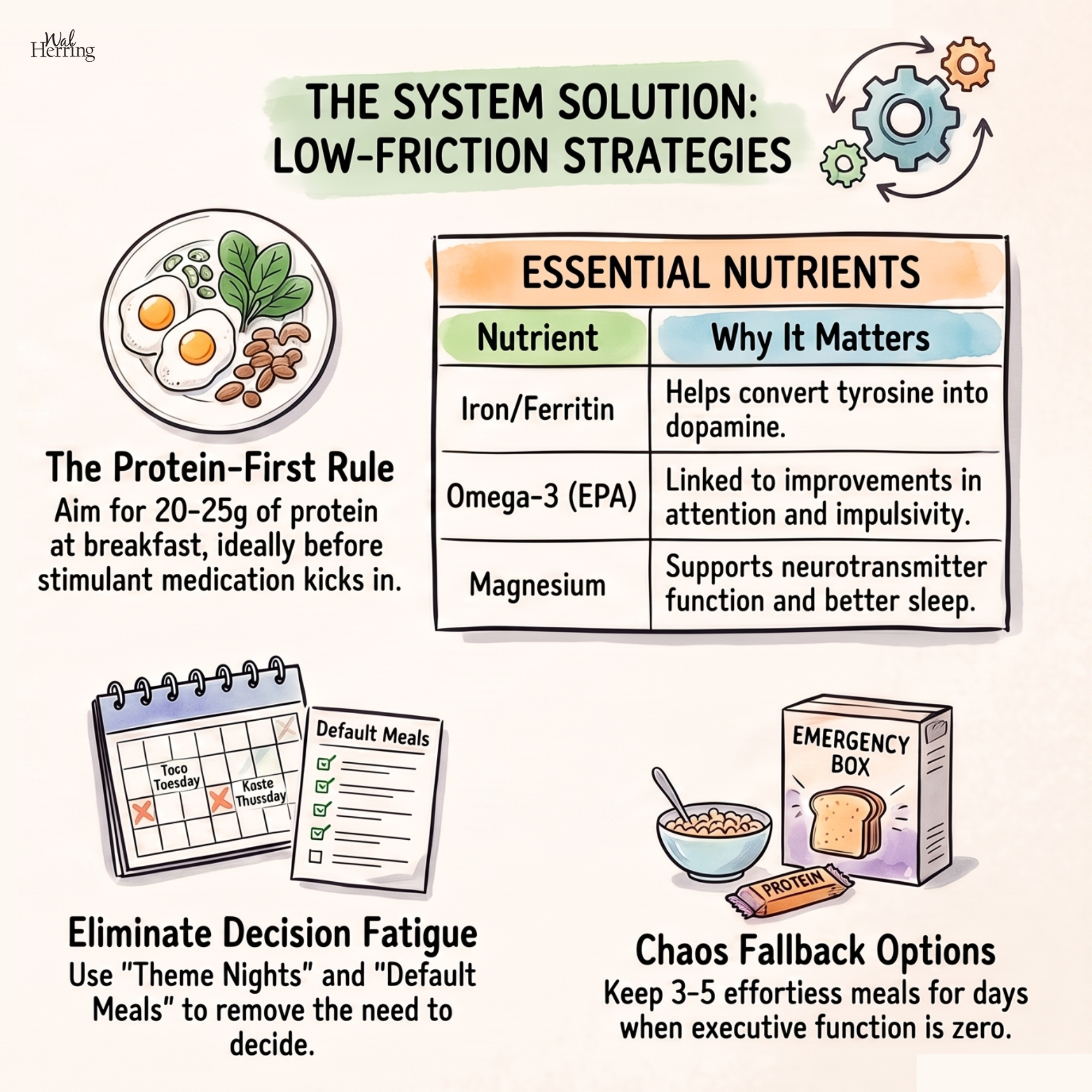
Protein and tyrosine. The raw material for dopamine. Aim for protein at every meal, not just dinner. Twenty to twenty-five grams at breakfast is the target. Eggs, Greek yogurt, cottage cheese, smoked salmon, a protein smoothie. It doesn't need to be elaborate. It needs to happen.
Iron and ferritin. Iron is a cofactor for the enzyme that converts tyrosine into dopamine. Low ferritin is consistently linked to worse ADHD symptoms, including inattention and impulsivity. Women who are still menstruating or in perimenopause with irregular and sometimes heavy bleeding are particularly at risk. Get your ferritin tested. If it's low, food sources first, red meat, legumes, dark leafy greens, always paired with vitamin C to help absorption. Supplement if your GP recommends it, but don't guess.
Vitamin D. Consistently lower in people with ADHD, and linked specifically to worse inattention. Easy to test. Easy to correct once you know what you're working with.
Omega-3. The most researched supplement for ADHD. The evidence isn't dramatic but it's real and consistent. Small but meaningful improvements in attention and impulsivity, especially when EPA is the dominant form. Aim for oily fish two to three times a week, or a supplement with at least 500 to 600mg of EPA if fish isn't happening. This one genuinely matters.
Magnesium. Involved in neurotransmitter function and sleep quality. Deficiency is common and symptoms overlap heavily with ADHD, poor concentration, irritability, disrupted sleep. Get it through food first, nuts, seeds, leafy greens, dark chocolate. Magnesium glycinate is a well-tolerated supplement form that also supports sleep, which is worth knowing if that's a struggle too.
B vitamins, especially B12 and folate. Cofactors for neurotransmitter synthesis. B12 in particular has been linked to inattention severity. Worth including in any blood panel alongside ferritin and vitamin D.
The honest message here is: test first, supplement where there's an actual gap, and don't megadose anything without knowing your baseline.
Correcting a real deficiency is meaningful. Supplementing randomly is expensive and often pointless.
Why meal timing matters more than you think
The ADHD brain doesn't have a reliable internal hunger clock. Time blindness means hours pass without the brain registering that it hasn't eaten. By the time hunger breaks through, it's urgent and the decision-making capacity to eat something balanced has long gone.
This is why regular meal timing needs to be external and automatic. Not something you remember to do. Something your environment makes happen.
Three meals a day, roughly every four to five hours, plus a snack if needed, keeps blood sugar stable, keeps tyrosine supply steady and prevents the late-day crash and overeat pattern. It sounds simple. For the ADHD brain it requires structure that doesn't depend on memory or willpower.
If you take stimulant medication, eat breakfast before your medication kicks in. Appetite is available in the morning. Once stimulants peak, it disappears. A protein-rich breakfast eaten before your first dose is one of the most important nutritional habits you can build.
The real problem: the system, not the food
Here's what most nutrition advice misses entirely.
The ADHD brain doesn't fail at eating well because it doesn't know what healthy food is. It fails because every step between knowing and doing requires executive function that is unreliable on the best days and non-existent on the worst.
So the solution is to remove the steps. Not to try harder at the steps.
This is the shift from a plan to a system. A plan tells you what to eat each day and adds decisions. A system eliminates decisions in advance so the right choice is also the easy choice.
Here's what that looks like in practice.
Default meals on rotation. Three or four breakfast options. Two or three lunches. A handful of dinners. These rotate on repeat. This is not boring. This is strategic. The brain that doesn't have to decide what to eat can put that energy toward something else.
Theme nights. Taco Tuesday. Pasta Wednesday. Stir fry Thursday. It sounds basic but it removes one of the biggest friction points in the day. The decision has already been made.
Ingredient prep, not meal prep. Full meal prep is high activation energy and feels overwhelming. Cooking a batch of protein, roasting a tray of vegetables, washing and cutting some fruit, takes thirty minutes and means the components are there when you need them. Assembly, not cooking, is the goal on weekday evenings.
Chaos fallback options. Three to five genuinely effortless things you can eat when executive function has left the building. Cereal and milk. Scrambled eggs. A tin of tuna with crackers. A protein bar, piece of fruit and a handful of nuts. The goal on those days is not optimal nutrition. It is eating something. That is enough.
Habit stacking. Attach eating to something that already happens automatically. Coffee brewing in the morning triggers breakfast. A midday alarm on your phone labelled "eat something" replaces the internal clock your brain doesn't have. The meal doesn't have to happen because you remembered. It happens because the cue fired.
Visual cues. Put food at eye level. Keep fruit on the bench, not in the crisper drawer. Store pre-cut vegetables in a clear container at the front of the fridge. The ADHD brain responds to what it can see. If the healthy option is also the visible option, it wins.
Remove the ADHD tax. Every time you get to 6pm and can't think of what to eat and order expensive takeaway out of desperation, that's the ADHD tax. A standing grocery order with your defaults removes one of the biggest triggers for it. Prep one day a week, even for twenty minutes, removes another.
A note on the restrict-binge pattern
This section matters and I don't want to skip it.
Women with ADHD have significantly elevated rates of disordered eating, including binge eating disorder. The pattern usually looks like this: appetite suppression from medication during the day, under-eating by default, and then by evening when the meds have worn off and executive function is depleted, eating large amounts of whatever is fast and easy, often followed by guilt and the decision to be "better" tomorrow.
If this is your pattern, I want to be clear: this is not a willpower failure. It is a physiological and neurological loop. And approaches that add more restriction to fix it almost always make it worse.
The answer is almost always more food earlier in the day, not less food at night. Regular eating during the day reduces the physiological driver of the evening overeat. It doesn't fix it overnight. But it changes the conditions that make it almost inevitable.
If binge eating is a significant pattern for you, please work with a professional who understands both ADHD and disordered eating. The intersection is real and common, and generic nutrition advice can cause harm here if it's not applied carefully.
Where to start
Not with an overhaul. With one thing.
The highest-impact, lowest-effort starting point for most ADHD women is a protein-rich breakfast (GET YOUR HIGH PROTEIN BREAKFAST IDEAS HERE) eaten at roughly the same time every morning.
That's it. Build that habit first. Let it stabilise. Then add the next thing.
Because the ADHD brain that tries to change everything at once changes nothing. The ADHD brain that changes one thing and makes it automatic builds something real.
You're not starting over. You're starting smarter.
Wal x
Perimenopause Decoded
Your symptoms are not random.
Find out exactly what your body is asking for.
Take the free Perimenopause Decoded quiz and find out exactly where to focus first.
Two minutes. No fluff. Just answers.
Recent Posts
READY TO STOP SECOND-GUESSING