How Much Protein Do You Really Need After 40?
You've heard it everywhere.
Eat more protein.
But how much? From what? And does it matter if you're not chasing a six-pack?
It matters. Not because you need to do more. Because your muscles have quietly changed the rules, and nobody sent you the memo.
The short answer
Most midlife women do well on about 1.2 g of protein per kilo of body weight a day. Up to 1.6 g if you're strength training or losing weight.
Spread it across three meals, aiming for roughly 25 to 35 g each. Pair it with some strength work two or three times a week. And keep the fibre coming alongside it.
Below you'll find your number, what it looks like on a plate, and a full sample day.
What's actually happening
The official recommendation is 0.8 g per kilo. For a 70 kg woman, that's about 56 g a day.
Here's the thing. That number was designed as a minimum for most healthy adults. Not a target for keeping muscle strong through midlife. And much of the research behind it was done in younger people, often men.
As we get older, muscle gets a bit harder of hearing. Researchers call it anabolic resistance. Your muscle still responds to protein, it just needs a bigger nudge to get the same message.
In one set of studies, older adults needed about 0.4 g of protein per kilo in a single meal to fully switch on muscle building. Younger adults needed about 0.24 g. That's roughly 60% more per meal. (Those studies were in men, so treat it as a guide for women, not gospel.)
The other piece: protein works best with strength training. In postmenopausal women, extra protein on its own didn't build muscle. Paired with resistance training, it did.
Protein is the support act. Lifting is the headliner.
What this means for you
Muscle isn't about looking a certain way.
➪ It's your metabolism.
➪. Your blood sugar control.
➪ Your balance, your bones, your ability to carry the shopping and get up off the floor at 85.
And most of us eat protein back to front. Toast and coffee for breakfast (maybe 8 g). A light lunch. Then a big serve at dinner.
That dinner might hit the mark. Breakfast and lunch usually don't.
What to do: protein through the STAC lens
STAC is my four-part filter for any food decision: Selection, Timing, Amount, Combination. Let's start with the one everyone asks about.
Amount: find your number
Use your current weight. Multiply by 1.2 for your everyday baseline, or 1.6 if you're lifting or losing weight.
|
Your weight |
Everyday (1.2 g/kg) |
Strength training or losing weight (1.6 g/kg) |
Per meal (about 0.4 g/kg) |
|---|---|---|---|
|
55 kg |
66 g |
88 g |
22 g |
|
60 kg |
72 g |
96 g |
24 g |
|
65 kg |
78 g |
104 g |
26 g |
|
70 kg |
84 g |
112 g |
28 g |
|
75 kg |
90 g |
120 g |
30 g |
|
80 kg |
96 g |
128 g |
32 g |
|
90 kg |
108 g |
144 g |
36 g |
If you're carrying more weight than you'd like, your coach or dietitian may work from a goal weight instead. That's a judgement call, not a rule.
Going much past 1.6 g doesn't seem to add more muscle. More isn't always better.
Timing: three anchors, not one big dinner
Aim for three meals that each hit your per-meal number. The easiest win is almost always breakfast, then lunch.
The research on perfectly even spreading is mixed. Your total for the day matters most. But three solid anchors is simply the easiest way to get there without a 60 g steak at 7pm.
Selection: What 25 to 30 g actually looks like
|
Food |
Serve |
Protein (approx.) |
|---|---|---|
|
Chicken breast, cooked |
100 g (palm-sized) |
30 g |
|
Lean beef or lamb, cooked |
100 g |
28 to 30 g |
|
Salmon or white fish, cooked |
120 g |
25 to 28 g |
|
Tinned tuna or salmon, drained |
95 g tin |
20 to 24 g |
|
Eggs |
2 large |
12 g |
|
High-protein Greek yoghurt |
200 g |
18 to 20 g |
|
Cottage cheese |
1/2 cup (125 g) |
14 g |
|
Firm tofu |
150 g |
18 to 22 g |
|
Tempeh |
100 g |
19 g |
|
Edamame, shelled |
1 cup |
17 g |
|
Lentils, cooked |
1 cup |
18 g |
|
Chickpeas, cooked |
1/2 cup |
7 g |
|
Pumpkin seeds |
2 tablespoons (20 g) |
5 to 6 g |
|
Milk or soy milk |
250 ml |
8 to 9 g |
|
Whey or soy protein powder |
1 scoop (30 g) |
20 to 25 g |
Approximate values. Brands vary a lot, especially yoghurt and tofu, so check the label. For yoghurt, look for 8 to 10 g protein per 100 g.
Mix your sources. Eggs, fish, dairy, lean meat, tofu, tempeh, lentils, beans. Each brings its own package of nutrients. In a large study of older women, more plant protein was linked to lower frailty risk, so legumes and soy earn a regular spot.
Combination: protein never travels alone
Here's where my 1-2-3 Meal Guide comes in: feed your body, feed your gut, feed your brain.
Protein feeds the body. But when protein goes up and fibre stays low, your gut bacteria shift toward less helpful by-products. In one trial where people doubled their protein but kept their fruit and veg up, that shift didn't show up.
So every time you lift your protein, add a plant. Veg, legumes, wholegrains, seeds, fruit. That's feeding your gut.
A full day on a plate (about 95 g, for a 70 kg woman)
|
Meal |
What's on the plate |
Protein |
|---|---|---|
|
Breakfast |
200 g high-protein Greek yoghurt + High-Protein Granola (get my recipe + other good breakfast options here) |
~25 g |
|
Lunch |
Big salad with a 95 g tin of tuna, 1/2 cup chickpeas, leafy greens, cherry tomatoes, olive oil and lemon (If you are after practical recipe and ways to make lunches easier - There are lots of resources in my programme) |
~28 g |
|
Afternoon |
Yoghurt and an apple |
~8 g |
|
Dinner |
120 g baked salmon, 1/2 cup lentils, roast veg, a drizzle of tahini |
~35 g |
|
Total |
~96 g |
That sits comfortably in the 84 to 112 g range for a 70 kg woman. No shakes. No weighing every gram. Just food.
Swaps that keep the protein
- Breakfast: 2 eggs on grainy toast with 60 g smoked salmon (~26 g). Or a smoothie with a scoop of protein powder, milk and frozen berries (~30 g).
- Lunch: leftover chicken (100 g) in a wrap with hummus and salad (~35 g). Or a lentil and veg soup with a boiled egg on the side (~24 g).
- Plant-based day: tofu scramble with spinach (150 g tofu, ~20 g) · tempeh and edamame stir-fry (100 g tempeh + 1/2 cup edamame, ~28 g) · lentil dahl with soy yoghurt (~25 g). Soy is your strongest plant all-rounder.
- Low-appetite or GLP-1 days: eat the protein part of the plate first. A protein smoothie or yoghurt pot can carry a whole meal's worth in a few mouthfuls.
Try this week
Just breakfast. That's it.
Lift it to around 25 g of protein, five days this week. Then notice: How's your energy at 10am? Are you hunting the biscuit tin at 3pm?
Your body will tell you whether it's working.
What the research says (the honest version)
- Muscle: across dozens of trials, eating more protein added a small extra boost to muscle and strength when people were also doing resistance training (meta-analysis, 2022). Gains levelled off around 1.6 g per kilo (Morton 2018).
- Women specifically: in postmenopausal women, extra protein helped muscle only alongside strength training (meta-analysis, 2022). One small trial found about 1.2 g per kilo gave a little extra boost to everyday function (Nahas 2019).
- Per meal: older muscle needed about 0.4 g per kilo per meal to fully respond, in men (Moore 2015).
- Sleep: in two small trials of middle-aged adults losing weight, higher protein (about 1.5 g per kilo) came with better sleep scores (Zhou 2016). Promising, but early.
- Bones: higher protein intakes are linked to fewer hip fractures in older adults (Groenendijk 2019).
- Kidneys: in healthy adults, higher-protein diets didn't harm kidney function (Devries 2018).
What we don't know yet: almost no studies look at women in their 40s and early 50s, or the perimenopause years specifically. These numbers are a well-supported starting point, not a precise prescription. Your body gets a say too.
When to get more support
Talk to your GP or an accredited practising dietitian before lifting your protein if you:
- have kidney disease or have been told your kidney function (eGFR) is reduced
- have diabetes or high blood pressure and haven't had kidney bloods done recently
- are on a GLP-1 medication and struggling to eat enough, or losing weight fast and feeling weaker
- have unexplained weight loss, falls, or a noticeable drop in strength
- have a history of disordered eating, where counting grams may not be helpful. There are gentler ways in.
You don't have to get this perfect
You don't need an app. You don't need to weigh your chicken.
Start with one meal. Notice how you feel.
Your body has been looking after you for decades. This is just you looking after it back.
Eating less was never the answer. Eating smarter is.
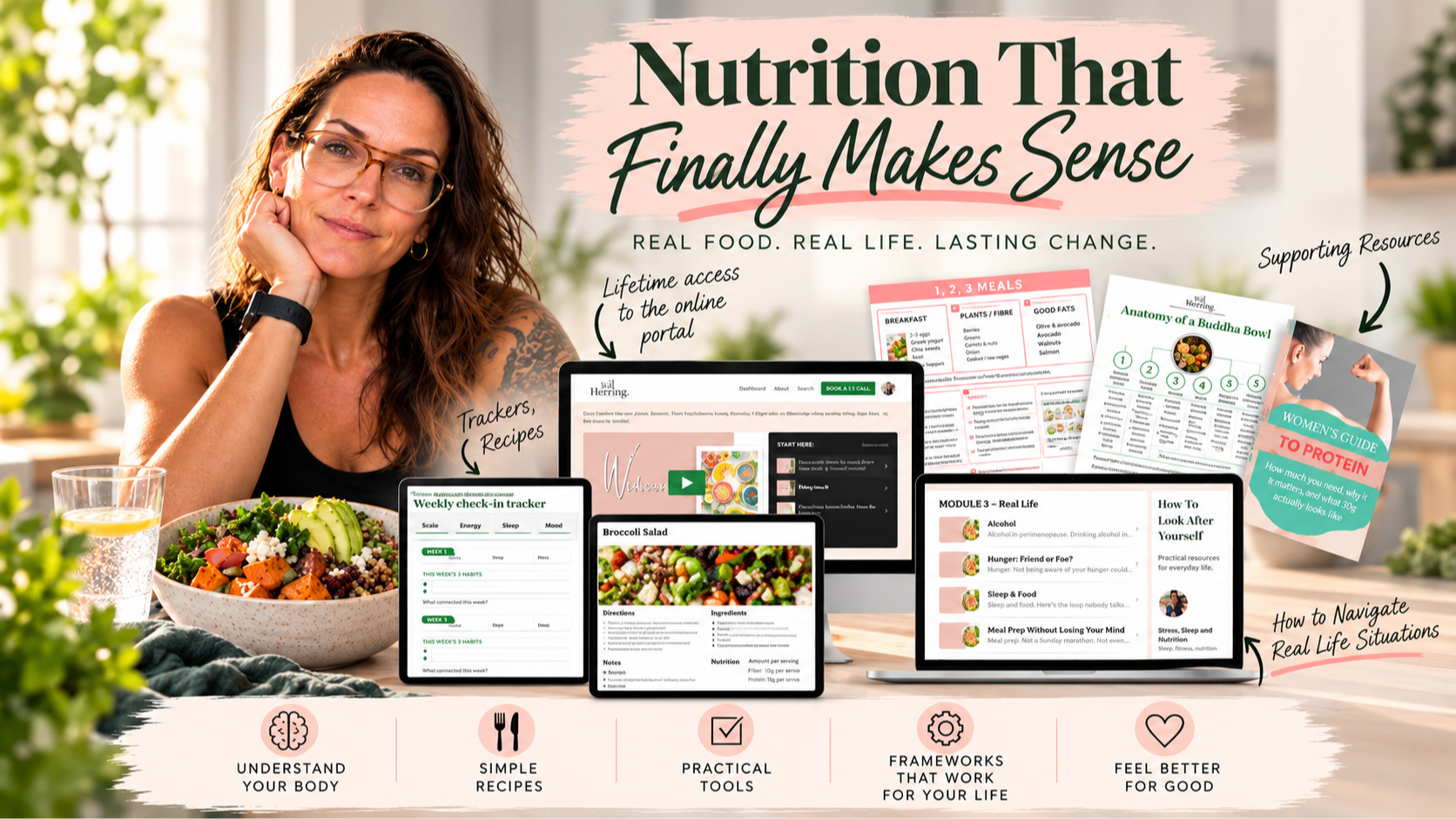
Finally understand how food actually works with your body.
Not rigid rules. Frameworks that work with your lifestyle, your body, your reality.
Recent Posts
READY TO STOP SECOND-GUESSING