Perimenopause is a vulnerable window for low libido.
It's 9.40pm. The kitchen's finally clean, you've signed the permission note, answered your sister's text about Mum's appointment, and now you're lying in bed scrolling. Your partner's hand lands on your hip and your whole body quietly says, please, not tonight.
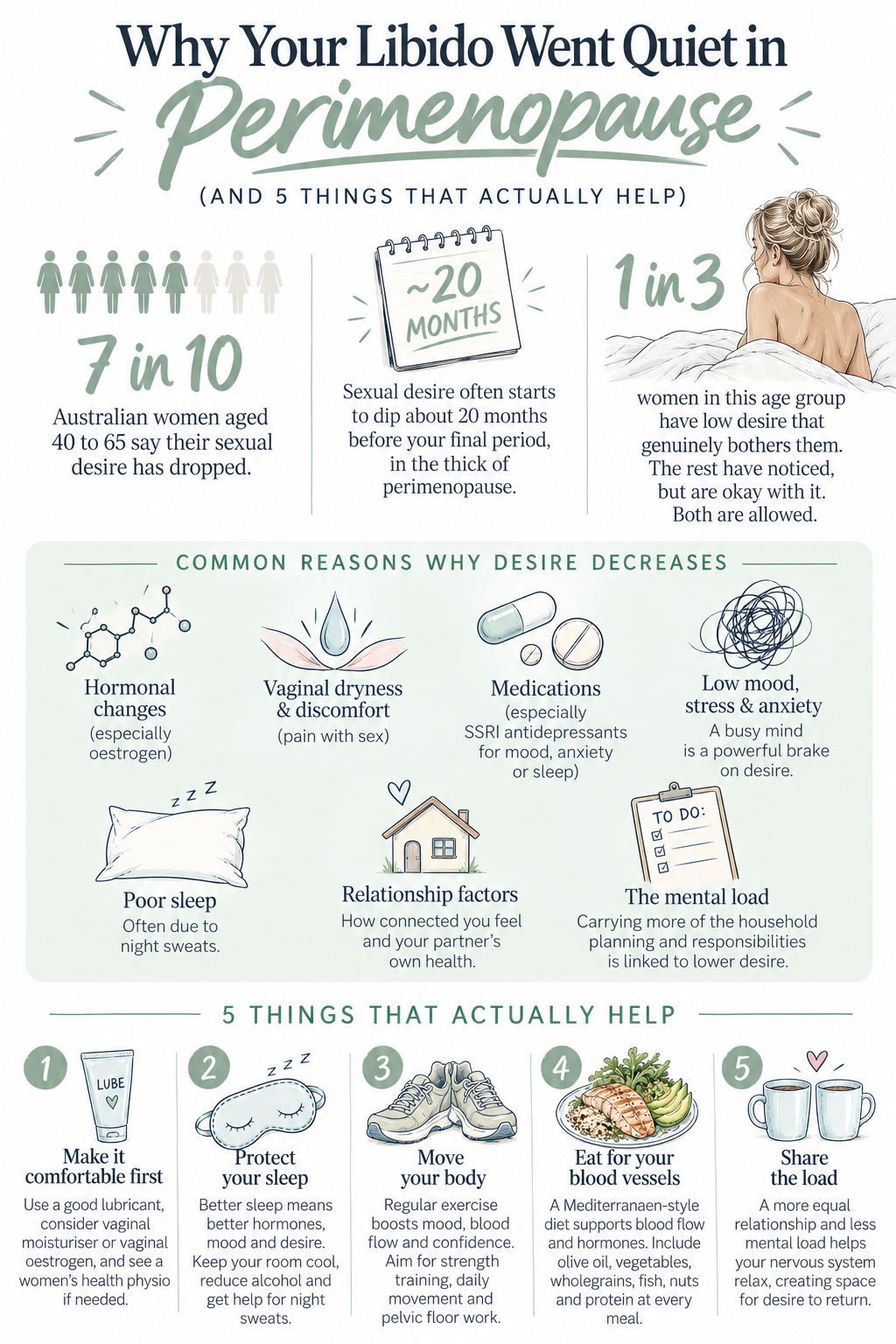
If that's familiar, you're in very good company. In a study of more than 2,000 Australian women aged 40 to 65, close to 70% reported low sexual desire.
Most of us... In other words. Yet nearly every woman who raises this with me says it in a lowered voice, like a confession, as if she's the only one whose interest went missing somewhere around 44.
The timing isn't random. A large US study that followed women through menopause found sexual function starts to slide about 20 months before the final period, right in the thick of perimenopause, and the slide eases a year or so after. A 2025 Monash study of more than 5,000 Australian women found problems with desire roughly doubled in early perimenopause compared with the years before it.
I also want you to know that low desire on its own isn't a disorder. In that first Australian study, about a third of women had low desire that genuinely bothered them. Plenty of the others had noticed the change and were fairly relaxed about it.
You're allowed to be in either group. If you're happy with where things sit, there's nothing to fix. If it's been quietly gnawing at you, keep reading, because most of what helps has very little to do with your hormone levels.
Why it happens
Most women assume a blood test will explain it. Check the hormones, top up whatever's low, sorted.
When Professor Susan Davis's team at Monash looked into it, blood levels of testosterone and DHEA couldn't tell them which women had low desire and which didn't. What did line up with low desire was a far more ordinary list: vaginal dryness and the discomfort that comes with it, medications for mood, anxiety or sleep (SSRI antidepressants especially), low mood, and how things were going with a partner. Other research adds broken sleep, stress that never fully switches off, and who carries the mental load at home.
That last one made headlines in 2022. US researchers found women who did more of the household labour reported less desire for their partner, partly because they'd started to see their partner as someone who depended on them. It's hard to want someone you've just reminded, for the third time, to book their own dentist appointment.
The brake and the accelerator
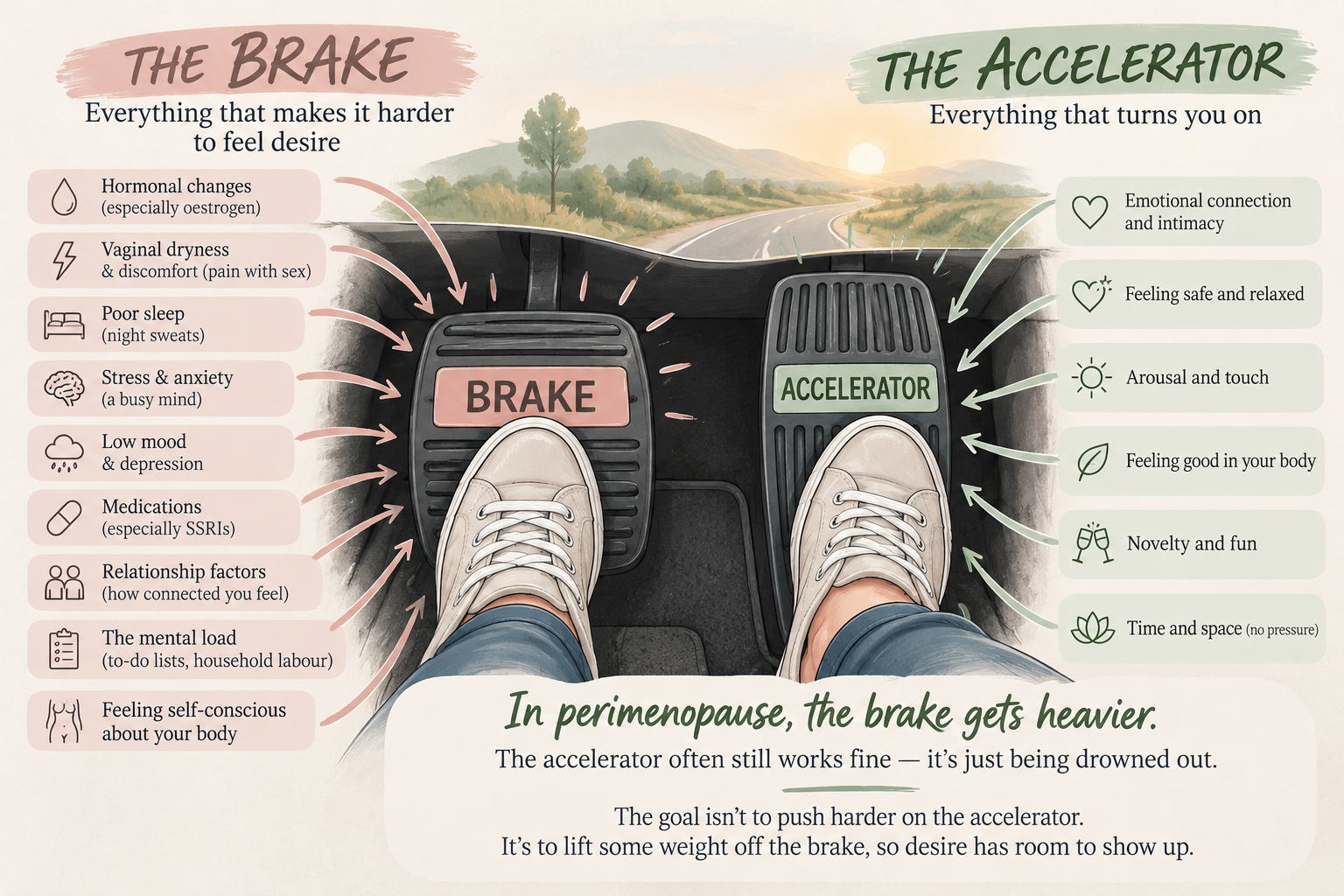
The model I come back to again and again with clients comes from sex researchers John Bancroft and Erik Janssen, and Emily Nagoski made it famous in her book Come As You Are. Your sexual response has an accelerator that picks up on anything that turns you on, and a brake that picks up on every reason to hold back: pain, exhaustion, resentment, feeling self-conscious about your stomach, the dishwasher still waiting to be unloaded.
Perimenopause loads the brake from several directions at once. Tissue gets drier, sleep gets choppier, your nervous system runs hotter and the to-do list keeps growing. For most women I see, the accelerator still works fine. It's simply being drowned out.
So I'd rather help you lift some weight off the brake than push harder on the accelerator. Desire has a way of coming back when there's room for it.
It also helps to know that in long relationships desire is often responsive. It tends to show up once touch and closeness have already started, rather than arriving out of the blue. Lots of women read that as a sign something's wrong with them. Researchers see it as one of the normal ways desire works, and plenty of men experience it too.
Five places to start
1. Get comfortable first
When sex has hurt a few times, your brain starts expecting it to hurt again and turns your interest down to protect you. It's a clever bit of self-protection, even if it doesn't feel that way at 10pm.
Dryness, burning, stinging and pain with sex all come under genitourinary syndrome of menopause, the medical name for what happens to vulval and vaginal tissue as oestrogen drops. In the long-running SWAN study, the share of women with vaginal dryness climbed from about one in five to one in three as they moved through menopause. Left alone it tends to keep going. Treated, it usually improves a lot.
A good lubricant every single time is the easy first step, along with a vaginal moisturiser used a few times a week on non-sex days to keep tissue comfortable. Low-dose vaginal oestrogen is worth asking your GP about too. It works locally and has some of the strongest evidence we have for dryness and painful sex. If you've got pain, leaking, or a pelvic floor that feels clenched or weak, a women's health physio can help with all of it, and that matters because worrying about leaking is a brake of its own.
2. Protect your sleep
In one study, women logged their sleep and their desire every day for two weeks. Each extra hour of sleep went with more desire the next day and higher odds of having sex. It was a small study in young women, but anyone who's tried to feel sexy after four broken hours and a 2am night sweat already knows the answer.
In perimenopause, keep the bedroom cool and use layers you can kick off fast. Keep evening alcohol low, since it helps you drop off and then fragments the back half of the night. Morning light and a steady wake-up time, weekends included, help your body clock settle. And if night sweats wake you most nights, take that to your GP, because treating them can change your sleep quickly.
3. Move, and notice the afterglow
Exercise works on desire through mood, sleep, blood flow and how at home you feel in your own skin.
There's also a lovely little finding from Cindy Meston's lab in Texas. About 20 minutes of brisk exercise boosted women's physical arousal response for a short window afterwards. I wouldn't plan date night around a treadmill session, but a walk together after dinner or some bad dancing in the kitchen counts.
I'd aim for strength training two or three times a week for muscle, metabolism and bones, plus something that lifts your heart rate most days, even a brisk 20 to 30 minute walk. Pelvic floor work belongs here too, ideally with a physio checking your technique, since it's surprisingly easy to get wrong.
4. Eat for your blood vessels
Arousal is largely a blood flow event. The vessels that keep your heart healthy also supply your vulva and clitoris, so whatever looks after your arteries looks after your sex life.
Mediterranean-style eating has the best evidence here. In an Italian trial of people newly diagnosed with type 2 diabetes, those eating Mediterranean-style held on to their sexual function longer than those on a low-fat diet over about eight years. The likely reasons are healthier blood vessel linings, more nitric oxide (the molecule that lets vessels relax and fill) and less inflammation. Most of this research is in people with diabetes or metabolic problems, so for healthy women it's a sensible bet more than a proven fix.
On the plate, that looks like extra virgin olive oil as your main fat, legumes, vegetables and wholegrains most days for fibre and steadier blood sugar, oily fish like salmon or sardines a couple of times a week, and a handful of nuts or seeds. Get protein in at every meal so you're not running on fumes by 3pm, which is 1-2-3 doing its job. Go easy on alcohol as well: one glass might loosen you up, but regular drinking dulls arousal and wrecks sleep.
Please don't read any of this as a reason to eat less. Under-fuelling leaves you flat and exhausted, and exhaustion leans on the brake harder than almost anything.
5. Share the load
If you're the one tracking every school form, birthday, bill and dinner, your nervous system rarely gets to land, and desire needs you to land.
An Australian study found women in more equal relationships reported more relationship satisfaction, and through that, more desire. A few things make the conversation easier. Hand over whole jobs from start to finish: your partner owns the groceries now, including noticing you're out of milk. Have the talk somewhere other than the bedroom, and frame it around wanting more of each other. Build in touch that doesn't have to lead anywhere, since affectionate touch measurably calms the stress response and takes the pressure off. And talk about responsive desire together, because once you both know wanting can come after starting, everything gets a bit lighter.
Come at it as a team asking for room, and it lands very differently.
Worth knowing on the medical side
Lifestyle comes first for me, though it's rarely the whole picture. If your desire vanished after starting an antidepressant, that's a well-known side effect, so talk to your prescriber about options and please don't stop it suddenly yourself. Menopausal hormone therapy can help indirectly by settling night sweats, sleep and dryness. For postmenopausal women whose low desire genuinely distresses them, testosterone is an option after a proper assessment, and there's a female-specific cream available on prescription in Australia. On average it adds close to one extra satisfying sexual experience a month, so it works best alongside everything above.
Go gently
If your desire has gone quiet, your body is responding sensibly to a season that asks an awful lot of you: less sleep, more load, tissue that's changing, and a nervous system that hardly ever gets to exhale.
You can want pleasure in midlife and still take your time getting there. Pick whichever brake feels lightest to shift, whether that's lube in the bedside drawer, an earlier night or handing over the grocery list, and start there.
If you'd like support working through this in your own body and life, that's exactly what we do inside my one on ones - book a free call to see if my coaching is right for you.
Sources
- Worsley et al. 2017, low desire and distress in Australian women aged 40 to 65
- Avis et al. 2017, SWAN: change in sexual functioning over the menopause transition
- Monash University 2025, sexual dysfunction in women at midlife
- Davis et al. 2005, androgen levels and sexual function in women (JAMA)
- Harris et al. 2022, household labour and women's sexual desire
- Kalmbach et al. 2015, sleep and next-day sexual desire
- Meston lab, exercise and sexual arousal in women
- Maiorino et al. 2016, Mediterranean diet and sexual function in type 2 diabetes
- Global Consensus Position Statement on testosterone in women, 2019
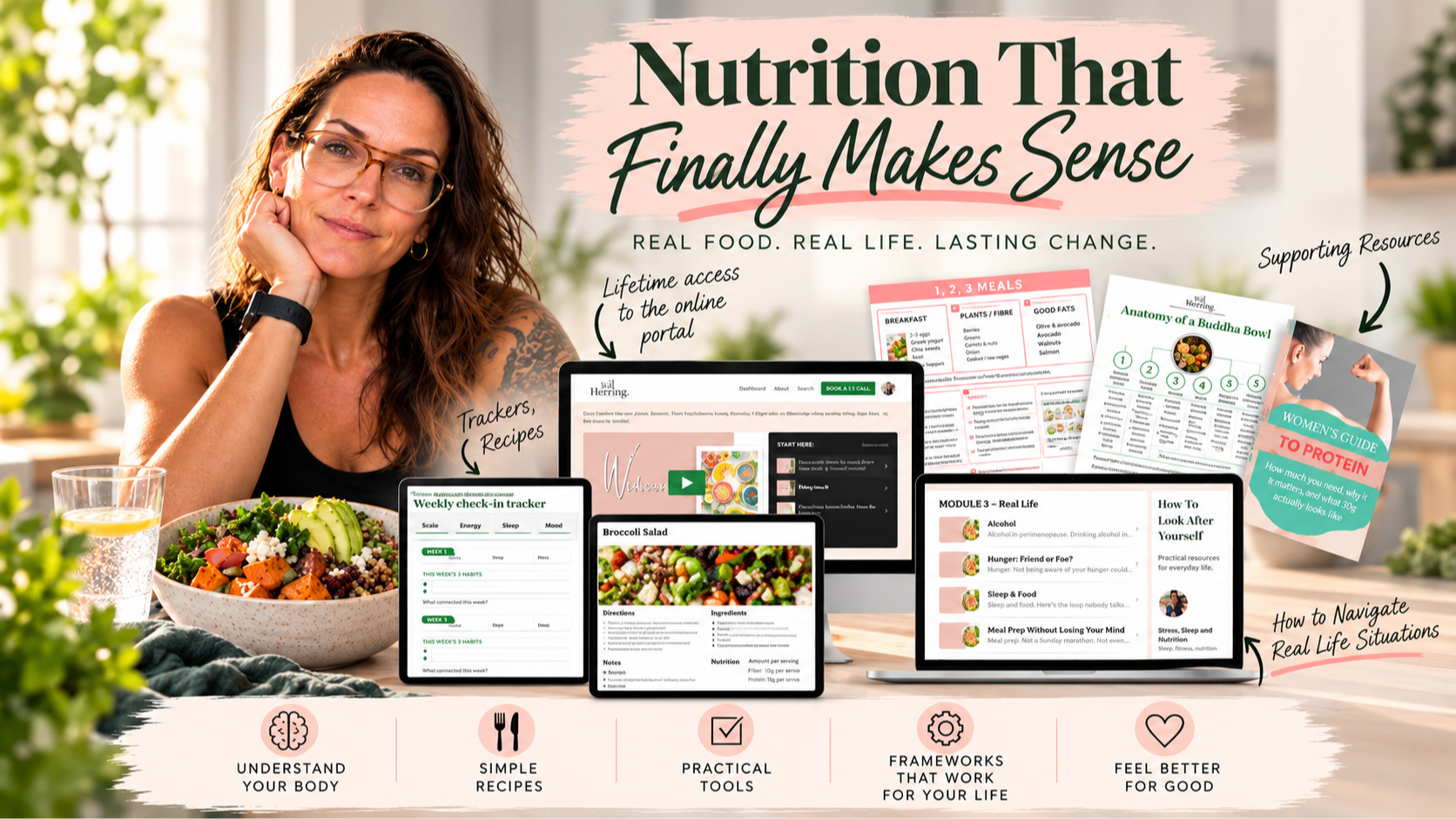
Eating less was never the answer. Eating smarter is.
Finally understand how food actually works with your body.
Not rigid rules. Frameworks that work with your lifestyle, your body, your reality.
Recent Posts
READY TO STOP SECOND-GUESSING