Softer, hungrier, meno belly? It's one switch

You've hit midlife and something's shifted.
You feel softer. Not necessarily heavier, just softer. Around your arms. Around your middle. Your jeans still do up, they just sit differently.
You're hungry. Properly hungry. You eat lunch, and an hour later you're standing at the pantry wondering what on earth just happened.
And there's a belly that seems to have arrived out of nowhere.
Here's the most frustrating part. You haven't done anything wrong. You're walking. Maybe you're at the gym. You're eating pretty well. You're doing all the things that have always worked, and now they just don't.
I hear this every week, from clients, in my DMs, in the comments. So I want to tell you something that I hope lets you exhale a little.
Your body hasn't stopped working. It's lost a bit of its metabolic flexibility. And flexibility can be trained.
If you prefer to watch than read... Check out the youtube clip on this.
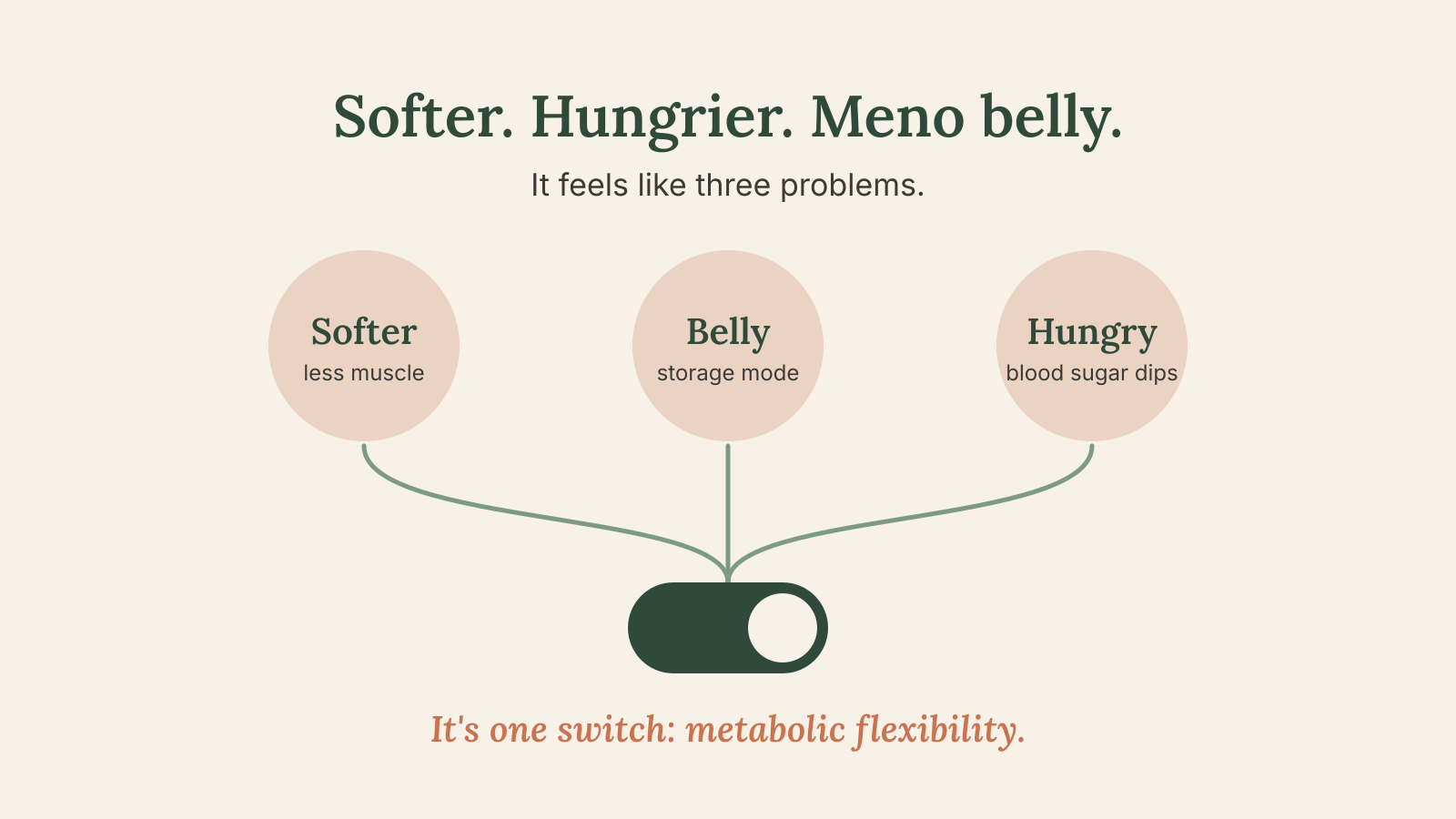
The softness, the belly and the hunger feel like three separate problems.
They're not.
They're connected.
And once you see how, it changes how you look at everything else.
What you're actually feeling
Most advice skips this bit. Let's not.
Why you feel softer
You can weigh exactly what you weighed in your 30s and have a completely different body.
From around our mid-30s we start losing muscle. In perimenopause, that speeds up. So the scale says nothing's changed, but the ratio has. A bit less muscle. A bit more fat.
Muscle is what gives you that firm, strong feeling. Less of it is the softness.
Why the belly
Before perimenopause, oestrogen tends to store fat around our hips and thighs. As oestrogen starts to swing and then drop, storage moves to the middle.
And it's not just under the skin. It goes deeper, around your organs. This is visceral fat.
The SWAN study, which has followed women through menopause for decades, found visceral fat climbs roughly 6 to 8% a year through the transition, with the steepest rise starting about two years before the final period.
So no, you're not imagining it. It's real. It's measurable.
And it's not your fault.
Why you're so hungry
This one doesn't get talked about enough. So many women tell me they're hungry all the time, even straight after eating.
Never quite satisfied.
Part of it is hormonal. Oestrogen plays a role in your appetite and fullness signals.
Part of it is sleep. We'll get there below.
And part of it is blood sugar. When your body struggles to manage glucose, you get the rise, then the drop. That drop feels like hunger. Loud. Urgent.
Three problems, or one?
Most advice treats these separately. Eat less for the belly. More cardio for the softness. White-knuckle the hunger.
That's exactly why it isn't working.
They're not three problems. They're three signs of one thing: metabolic flexibility.
So what is metabolic flexibility?
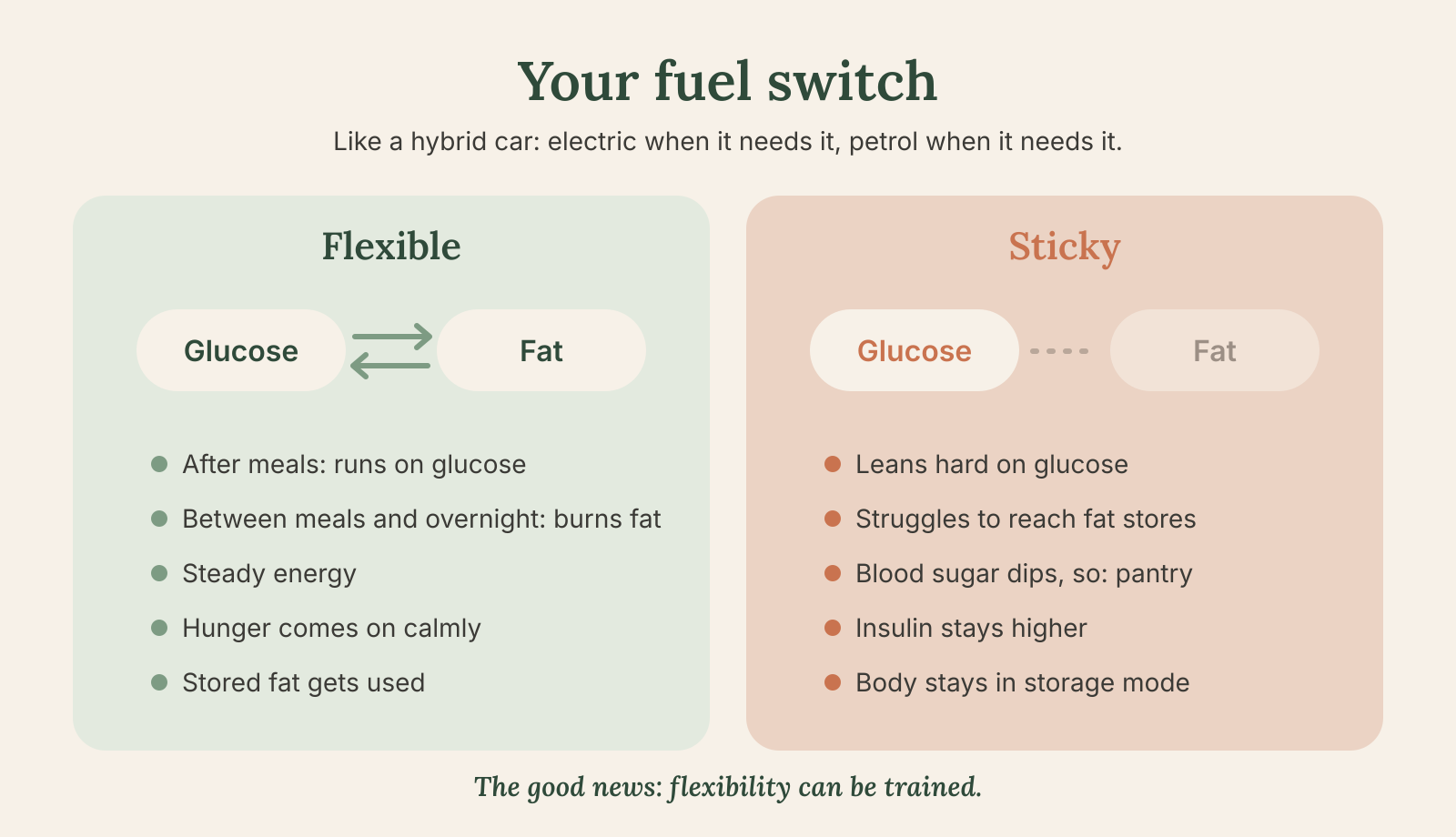
It's your body's ability to switch between fuel sources.
You've got two main ones. Glucose, which is sugar, mostly from carbs. And fat, from the food you eat and from what you've got stored.
When your body is flexible, it uses the right fuel at the right time.
After a meal, it runs on glucose from that meal. Between meals, overnight, or on a gentle walk, it switches over and burns fat. Smoothly.
You don't even notice.
I think of it like a hybrid car. Electric when it needs it. Petrol when it needs it. It switches between the two without a fuss. No gear change.
That's a flexible metabolism. Steady energy. Hunger that comes on calmly. Stored fat that actually gets used.
When the switch gets sticky
Metabolic inflexibility is what happens when that switch gets a bit stuck.
Your body leans heavily on glucose and isn't great at getting into fat stores between meals.
So when your blood sugar dips, your body says I need fuel, now. It doesn't reach for the fat you're carrying. It sends you to the pantry.
That's the hunger.
When you're running mostly on glucose, and glucose is coming in often, insulin stays a bit higher. Insulin is a storage hormone. Its job is to tuck fuel away. When it's hanging around, your body is in storage mode, not release mode.
That's the belly.
Now here's where it all ties together.
Where does most of that fuel switching happen?
In your muscle.
Muscle is the biggest place your body clears glucose. It's packed with mitochondria, the little engines inside your cells that burn fuel. More muscle, more engines, more places for fuel to go.
So when you lose muscle in midlife, you're not just losing firmness. You're losing capacity. You're losing flexibility.
That's the softness.
Softer. Belly. Hungry. One switch.
And here's the bit I really want you to hear.
Metabolic flexibility isn't fixed.
It's not your genes.
It's not your age.
It responds to signals: how you eat, how you move, how you sleep, and how safe your body feels.
Which means you can change it.
Why it goes a bit haywire in our 40s and 50s
A few things shift at once. When they stack, the dominoes fall.
Oestrogen
Oestrogen does so much more than run your cycle. It helps your cells respond to insulin. It shapes how your muscle uses fuel.
As it swings through perimenopause and drops after menopause, your body becomes less sensitive to insulin. Less sensitivity means more insulin to do the same job. More insulin, more storage mode.
One study measured women before, during and after the transition. Postmenopausal women had the poorest metabolic flexibility during moderate exercise, burning noticeably less fat than premenopausal women.
So the walk you did at 35 is literally being fuelled differently now. That's not in your head.
Muscle
Muscle gets harder to keep. And there's another layer called anabolic resistance.
Fancy term. It just means your muscles become a little less responsive to the protein you eat. Lower oestrogen plays a part.
So you need a stronger signal to hold on to the muscle you've got. A bigger dose of protein. A heavier load in the gym. The quiet signal that worked at 30 doesn't cut it anymore. Hold that thought, we're coming back to it.
Sleep
Night sweats. 3am wake-ups. A brain that won't switch off. Midlife sleep can be rough.
But sleep isn't separate from your metabolism. It's right in the middle of it.
A trial from Columbia University had women sleep about an hour and a half less than usual. Not all-nighters. Just a bit less, for six weeks. Insulin resistance went up nearly 15%. In postmenopausal women, it was over 20%.
Short sleep also messes with your hunger hormones. You're hungrier the next day and less satisfied when you eat. So that wicked craving after a rough night? Not weakness. Biology.
Stress
Teenagers. Ageing parents. Work. Holding it all together.
When your body is under constant stress, cortisol stays up. Cortisol's job is to make fuel available for an emergency. So it nudges blood sugar up, which nudges insulin up, which nudges storage up.
Your body reads the signal: things aren't safe, hold on to everything.
Dieting history
For so many of us, there's one more layer. Decades of eating less. Skipping breakfast. Coffee for lunch. Cardio to burn it off.
Undereating, especially undereating protein, costs muscle. And losing muscle costs flexibility.
So you can see why the old rules backfire now. Eat less, move more, try harder. That just stresses a system that's already asking for support.
Your body isn't broken. It's asking for different inputs.
Five levers to retrain the switch
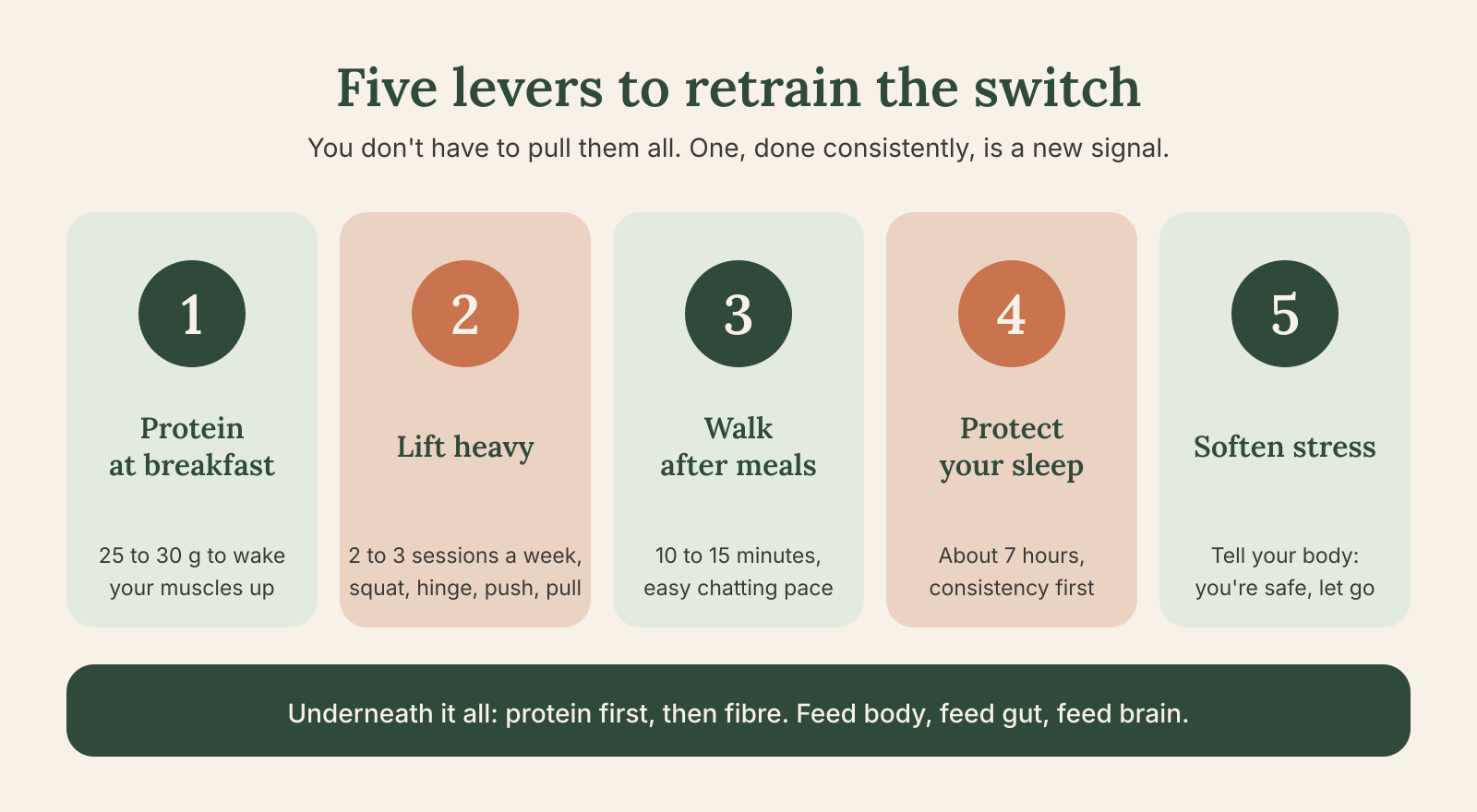
You don't have to pull them all. Even one, done consistently, sends your body a new signal.
1. Protein at breakfast
If I could change one thing for women in midlife, it would be this. It's where I start with nearly every client.
Remember anabolic resistance?
Your muscles need a bigger signal right now.
Research suggests that signal really kicks in at about 25 to 30 grams of protein in a meal. Below that, your muscles don't quite get the message to rebuild.
Here's the catch. Most women eat the least protein of the whole day at breakfast. Toast. Cereal. Maybe just a coffee. That's barely 10 grams. Most of our protein lands at dinner, so muscles get one decent signal a day, if that.
Move some protein to breakfast and three things happen:
- A morning signal that says rebuild. That's the softness.
- Steadier blood sugar through the day, because protein slows everything down. That's the belly, over time.
- You're properly full. Protein-rich breakfasts turn down the brain signals that drive cravings later on. That's your 3pm and 9pm pantry run.
One meal. Three wins.
It doesn't have to be eggs every day. Greek yoghurt with berries and hemp seeds. Last night's leftovers. Smoked salmon on good grainy bread. A smoothie. I love my high-protein granola, real food with the protein and the fibre. Grab the recipe here along with my other 30-gram breakfasts.
2. Lift heavy
Protein is the signal. Strength training is what makes your muscles listen.
Muscle is where most of your glucose goes. When you strength train, you build more muscle and more of the little transporters that pull glucose out of your blood.
In one study, people trained just one leg for six weeks. The trained leg ended up with significantly more mitochondria than the untrained one. Same person. Same food. Just the training.
And this all happens before the scale moves, before your waist changes. Insulin sensitivity starts improving within days to weeks. Even if you can't see it yet, it's working.
You don't need to live in the gym. Two to three sessions a week. Big movements: squat, hinge, push, pull. Heavy enough that the last couple of reps feel like real work.
If the gym feels scary, you're not alone. Everyone seems to know what they're doing and you've no idea where to start. I made a six-week beginner program for exactly that. Step by step, every session filmed, so you walk in with a plan. Check it out here.
3. Walk, especially after meals
You don't need to push all that cardio. Lots of women find hard cardio makes them hungrier the next day.
What trains your fat burning is gentle, steady movement. A pace where you can still easily chat. You might hear it called zone 2.
The simplest version: a 10 to 15 minute walk after a meal. Your muscles soak up glucose while you move. Smaller spike. Smaller drop. Less hunger afterwards.
4. Protect your sleep
Remember that trial? An hour and a half less sleep and insulin resistance climbed. Flip that around. Protecting your sleep is one of the most powerful tools you've got, and it's free.
Aim for about seven hours, but consistency matters most.
- Finish eating about three hours before bed if you can
- Cool, dark room, and get the TV out of there
- No screens before bed
- Sunlight in your eyes in the first hour of waking
If night sweats or hot flushes are waking you, please talk to your doctor. It's worth sorting, and there are options.
5. Soften the stress signal
This is the one most people skip. I think it's the one midlife women need most.
Your body won't easily let go of stored fuel if it thinks it's in danger. So part of this work is giving your nervous system a different message: you're safe, this is enough, you can let go.
That might be five minutes of slow breathing in the morning sun. One slow breath before you eat. Saying no to one thing each week. Choosing a walk over a hard session on a day you've slept four hours.
Ease isn't something you earn once you've fixed your body. It's part of how you fix it.
Underneath it all: build your plate well
Protein first. Then fibre: veggies, legumes, whole grains, fruit. Your gut bugs love fibre, and a happy gut helps insulin sensitivity.
If you want this made simple, that's exactly what my 1-2-3 Meal Guide does. Feed your body, feed your gut, feed your brain. It's inside my course, and it makes eating sustainable for the long haul. Find it here.
How long does this take?
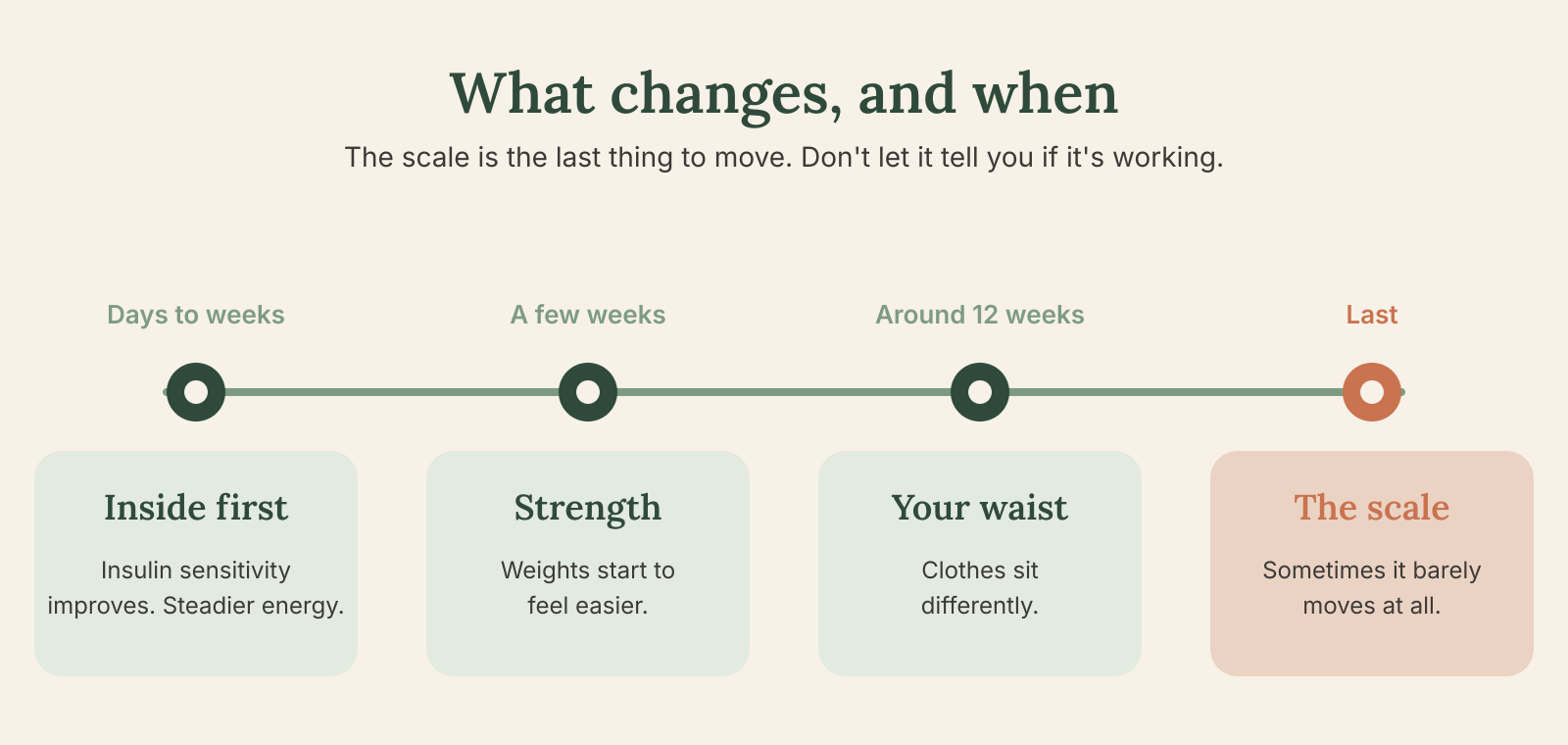
Here's roughly what the research says, in order.
- On the inside first. Insulin sensitivity improves within days to weeks of strength training and better sleep. You won't see it, but you'll start to feel it. Steadier energy. Less of that desperate hunger.
- Then strength. Within a few weeks, your weights start to feel a bit easier. That's real change.
- Then your waist. Around the 12-week mark, clothes usually start sitting differently. Exercise can reduce visceral fat even when weight barely moves.
- The scale comes last. Sometimes it barely moves at all while your body composition is changing.
So please don't let the scale tell you whether it's working.
Three things, one switch
You feel softer because you've lost some muscle.
You're gaining around the middle because oestrogen has shifted where fat is stored, and your body is spending more time in storage mode.
You're hungrier because the fuel switch has got a bit sticky, and your blood sugar and your sleep are pulling on your appetite.
And that switch responds to signals. Protein in the morning. Muscle that's asked to work. A walk after meals. Sleep that's protected. A nervous system that's allowed to settle.
You don't have to do it perfectly. You just have to start sending your body new signals.
Your body isn't failing you. It's asking for something a little different right now.
And you're allowed to give it that.
Eating less was never the answer. Eating smarter is.
Finally understand how food actually works with your body.
Not rigid rules. Frameworks that work with your lifestyle, your body, your reality.

Recent Posts
READY TO STOP SECOND-GUESSING