Body Literacy: The Skill Nobody Taught You (And Why It Matters More in Perimenopause)
You know your car needs a service when the light comes on the dashboard.
You know your phone needs charging when the battery hits 10%.
But do you know what it means when your sleep goes from solid to shattered for no reason? When your energy tanks at 3pm every single day? When your bowels change, your bloating gets worse, or your period suddenly does something it's never done before?
Most women don't. Not because we don't feel it. Because our whole health system is built on this idea: if something goes "wrong," go see a doctor.
First problem with that: why do things need to go wrong before we take action?
Second problem: you'll get far better outcomes from that doctor's visit if you can actually articulate what's going on in your body.
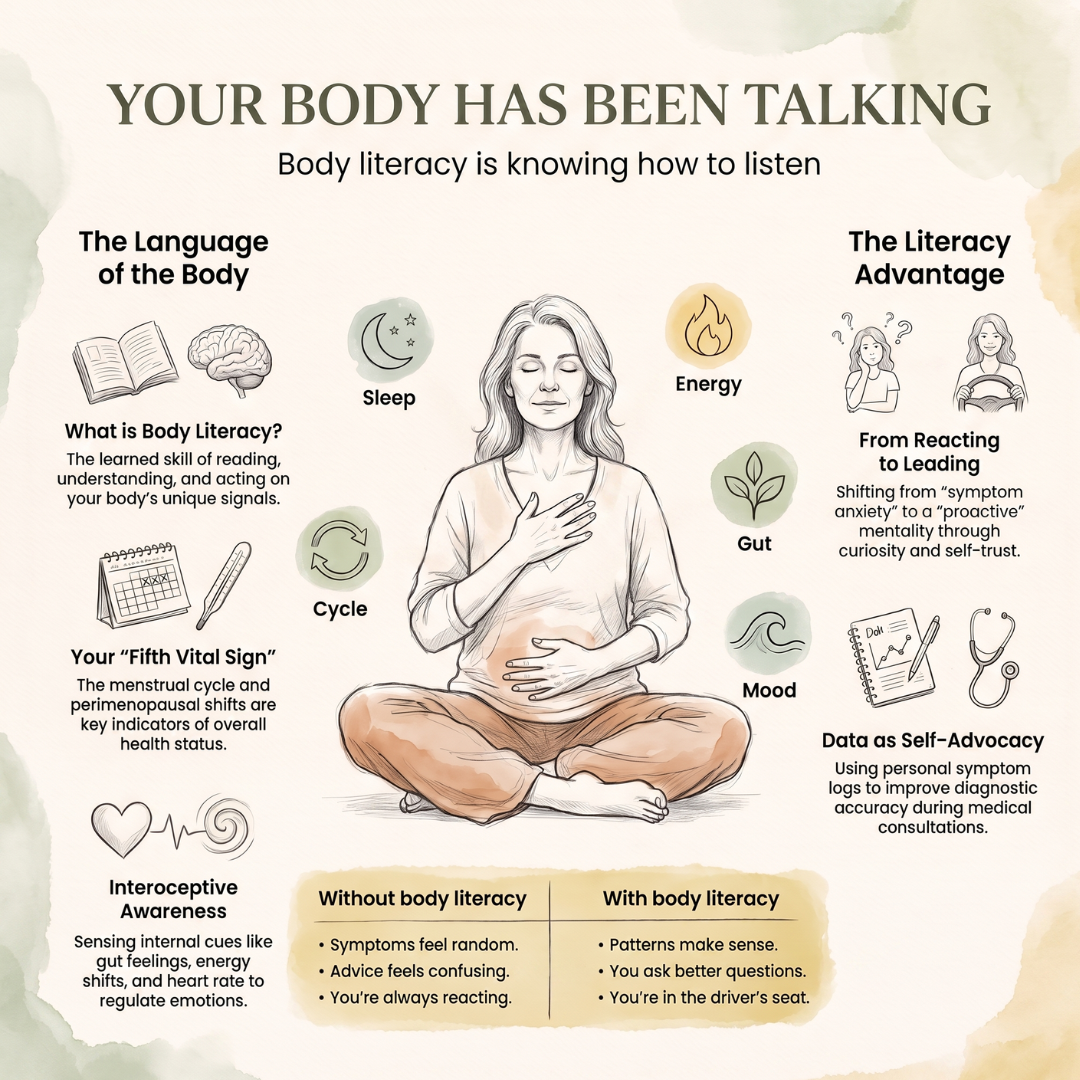
What no one ever taught us was how to understand our own body. That's body literacy.
It matters at every stage of life. But it matters especially through perimenopause. Because it's the difference between feeling blindsided by your body and feeling like you're actually in the driver's seat.
What body literacy actually is
Body literacy is simple: it's learning to read the signals your body sends you, so you can understand what's happening and respond well. Same idea as literacy with words. You weren't born knowing how to read English. Someone taught you the alphabet, then words, then sentences, until reading became automatic.
Nobody did that for your body. You were never sat down and taught what your normal bowel movements look like, what your normal sleep should be, what your normal cycle length is, or how to tell "having a hard day" apart from "my hormones are doing something."
So most women go into their 40s fluent in everyone else's needs and illiterate in their own biology. Then perimenopause hits, symptoms show up that nobody warned them about, and it feels like their body has betrayed them.
It hasn't. It's been talking the whole time. You just haven't had the training to understand the language.
Why this actually changes your health outcomes
This isn't just a nice metaphor. Knowing your body, and knowing what to do with what you find, actually changes what happens to you medically.
Doctors have known for a while that people who understand their own health tend to do better. Not slightly better. Studies on people managing serious conditions have found that those who struggle to understand their own health information are far worse off, even once you account for everything else going on.
Knowledge isn't just comforting here. It's protective.
Now bring that into perimenopause. Think about how many women end up on antidepressants when what's actually happening underneath is a hormonal shift nobody flagged. One hospital audit found this was true for the vast majority of women being treated for depression who were also going through perimenopause.
Not because their doctors weren't trying. Because nobody, including the women themselves, had enough of a pattern to see what was really going on.
And here's where it gets personal. Women are, on average, diagnosed later than men. Across almost every condition there is. Some take years longer to catch in women than in men. That gap isn't about biology. It's about how the conversation goes in the room. A vague "I just don't feel right" gets a different response than a clear pattern laid out on the table.
A woman who can say "my cycles have gone from 28 days to 19 over the last six months, my sleep has dropped from 7 hours to 5, and I'm waking up anxious three nights a week" gets a completely different conversation than a woman who says "I just don't feel like myself."
Same body. Different data. Different outcome.
The two things you need to know: what's normal, and what's YOUR normal
Body literacy has two layers, and you need both.
1. Layer one is the population map. This is knowing what's considered normal in general. A menstrual cycle usually runs 21 to 35 days. Bowel movements, healthily, range anywhere from 1-2 times a day to three times a week (yes, that's a wide range, and yes, that's normal). Most adults need 7 to 9 hours of sleep. In perimenopause, cycle length changing by 7 days or more from what it used to be is expected. So is more than a year without a period once you hit menopause proper.
This is your map. It tells you the general terrain everyone's walking through.
2. Layer two is your personal territory. The population map tells you what's common. It doesn't tell you what's you. Your normal cycle might be 26 days, not 30. Your normal might be one bowel movement a day, or two every second day. Your normal energy dip might be real, or it might be a red flag that something's shifted.
You can only know layer two by paying attention over time. And this is where most women have never had the chance to build the skill.
How to actually start
You don't need an app, a wearable, or a spreadsheet to begin. You need a notebook and about two minutes a day. Start noticing:
Your cycle. Length, flow, and how you feel across it, not just when it starts and stops.
Your bowels. Frequency and how they feel. This tells you more about your gut and your stress load than almost anything else. Does stress, food or your cycle change it?
Your energy. When it's high, when it crashes, and whether that lines up with food, sleep, or where you are in your cycle.
Your hunger. Are you actually hungry, or eating because it's midday and that's the rule? Are you ignoring hunger until you're ravenous?
Your symptoms. Are headaches getting more frequent, or more severe? Do they cluster at a certain point in your cycle? After certain foods? On the nights you barely slept?
Your relationship with food and emotion. Notice when you reach for food to soothe something that isn't physical hunger at all. Not to judge it. Just to see it.
That's it. You're not trying to fix anything yet. You're just building a record. Because you cannot manage what you cannot see, and right now, most women are trying to navigate one of the biggest hormonal transitions of their life with no map and no data.
A word on not tipping into obsessive
Here's the line worth drawing early, because it's easy to miss.
Body literacy is noticing. It's curious. It's "oh, interesting, that's the third headache this week, I wonder if it's linked to my sleep." You gather the data, you stay open, and mostly, you carry on with your day.
Hypervigilance is different. It's scanning for a threat. It's "why do I feel this twinge, what's wrong with me, let me check again in ten minutes." The moment tracking becomes about finding something wrong rather than getting to know what's normal for you, it's stopped being body literacy and started being anxiety.
The tell is simple. Curiosity feels light. You notice, you jot it down, you move on. Anxiety feels heavy. It loops. It wants certainty it can never quite get, so it keeps checking.
If you notice yourself needing to check constantly, spiralling on what a symptom "means," or feeling worse the more you track rather than more informed, that's your cue to step back. Bring in support. A GP, a nutritionist, someone who can hold the bigger picture with you, rather than trying to white-knuckle your way to certainty alone.
Body literacy is meant to make you feel more grounded in your body. Not more afraid of it. If it's doing the opposite, that's information too.
This is the starting point.
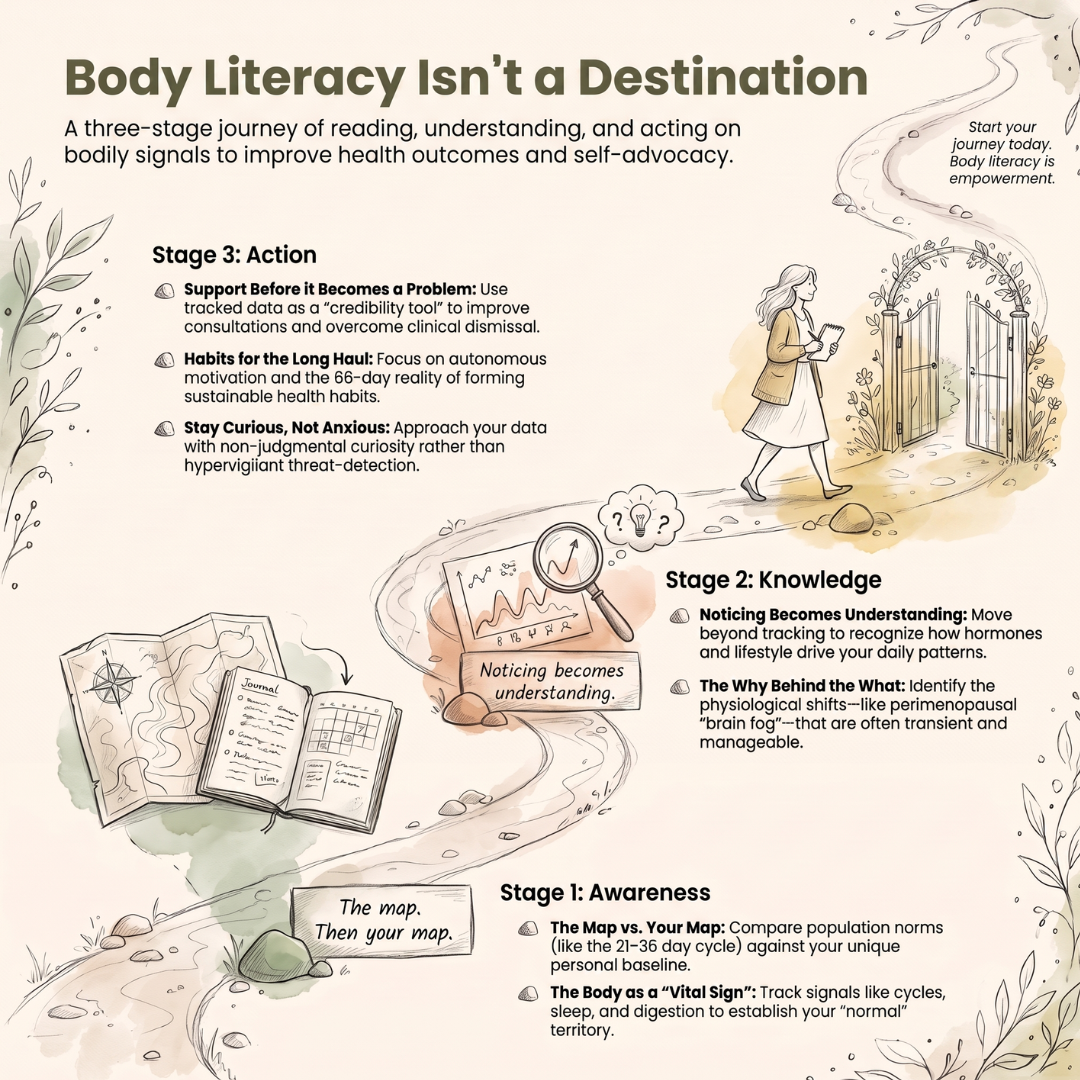
And it's really a path with three steps, even if you never think about it in those terms.
1) First you notice, building that record of your cycle, your bowels, your energy, your hunger, without judging any of it.
2) Then you start to understand what you're seeing, why energy dips before your period, why bloating spikes after certain foods or bad sleep, so the noticing turns into real insight.
3) And then you act on it. You adjust what you eat or how you move based on your own evidence, not a generic plan. You walk into appointments with a pattern instead of a vague complaint. That's the whole shift.
From guessing, to noticing, to knowing, to using what you know.
You're finally fluent in the one language that matters most: your own.
If you need help with this, Enquire about 1:1 coaching with me
Perimenopause Decoded
Your symptoms are not random.
Find out exactly what your body is asking for.
Take the free Perimenopause Decoded quiz and find out exactly where to focus first.
Two minutes. No fluff. Just answers.
Recent Posts
READY TO STOP SECOND-GUESSING